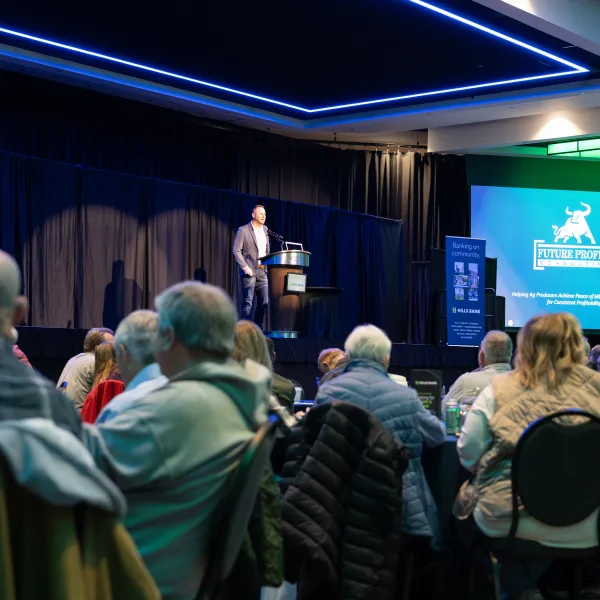
Schroeder Warns Farm Families: Poor Planning Fuels Costly Legal Disputes
Family conflict, not market volatility, may be one of the greatest threats facing farm businesses today, according to attorney Travis Schroeder of Simmons Perrine, who addressed Ag Outlook attendees on the legal risks tied to estate and succession planning.
Schroeder, whose practice focuses on representing farm families and business owners, centered his presentation on how unclear, outdated, or incomplete planning can lead to litigation that fractures families and jeopardizes the future of agricultural operations.
“Litigation is a real risk,” Schroeder told the audience. “And when it happens inside a family, nobody wins. The costs are enormous, relationships are destroyed, and the farm, the asset everyone was trying to protect, often does not survive the process.”
Family Fights Are Preventable
While Schroeder acknowledged that disputes cannot be eliminated entirely, he emphasized that many of the most common legal battles in agriculture are preventable through proactive planning.
He pointed to a shift away from informal agreements such as handshake leases and unwritten family understandings toward the need for clear, detailed documentation.
“The days of promises being enough are behind us,” he said. “If it is not written down, very clearly, you are creating risk.”
According to Schroeder, estate plans should be built not only around where assets are intended to go, but around what could go wrong. That includes anticipating remarriage, divorce, disability, creditor claims, and disagreements among heirs.
“We have to assume that what can go wrong eventually will,” he said. “Our job is to plan for those scenarios.”
The Danger of Waiting Too Long
One of Schroeder’s strongest warnings focused on delayed planning. He said outdated wills and trusts are a frequent source of family disputes, particularly when family dynamics, finances, or tax laws have changed.
Even more problematic, he said, is waiting until very late in life to begin planning.
“When someone comes in at 85 or 90 and wants to make major changes, litigation risk goes through the roof,” Schroeder said. “The window for effective planning narrows, and the likelihood of challenges increases.”
He urged families to review their plans every three to five years and after major life events, noting that frequent updates can actually reduce the risk of successful challenges by showing a consistent planning history.
Communication Reduces Conflict
Schroeder highlighted lack of communication as a leading cause of estate disputes, often more significant than the documents themselves.
Many older clients, he said, prefer not to share details of their plans with their children. While that is their choice, Schroeder warned that secrecy can increase suspicion and conflict after death.
“Especially when plans are not equal, but intended to be fair, communication is critical,” he said. “If heirs understand the reasoning while parents are still alive, they are far less likely to fight later.”
He also stressed the importance of communication among professional advisors, including attorneys, accountants, lenders, and insurance agents, to ensure estate plans function as intended.
Trusts as Risk Management Tools
A large portion of Schroeder’s presentation focused on the strategic use of trusts to protect assets from both internal family disputes and external threats such as creditors or lawsuits.
He explained that while revocable trusts are commonly used to avoid probate, they offer no creditor protection. More advanced structures such as marital trusts, discretionary trusts, and generation skipping trusts can provide layers of protection, depending on family circumstances.
“Trusts are not one size fits all,” Schroeder said. “The level of protection depends on how they are structured.”
He acknowledged that stronger protections often require longer, more complex documents, something many clients resist.
“I do not like how long my documents are either,” he said. “But simple and short is not always better if it leaves gaps that cause fights.”
Choosing the Right Fiduciaries
Selecting trustees, executors, and powers of attorney is another critical decision, Schroeder said. Poor choices can lead to deadlock, mistrust, and litigation.
He recommended avoiding even numbered fiduciaries when possible, using tie breaking mechanisms, and considering independent trustees such as banks when family dynamics are strained.
“Half of the disputes I see start not because of the documents, but because the fiduciary goes silent,” Schroeder said. “No information leads beneficiaries to assume something is wrong.”
Planning for Farm Succession
Schroeder noted that succession planning in agriculture is inherently more complex than in non farm estates, especially when some heirs farm and others do not.
He advised against co ownership among heirs who already struggle to work together and cautioned against allowing non operating heirs to own operating assets such as equipment or livestock.
“The goal should be clarity,” he said. “Who gets what, how it is valued, how buyouts work. Gray areas invite litigation.”
In some cases, Schroeder said, dividing assets during life may be the best way to avoid future disputes, even if it requires difficult conversations.
Protecting the Legacy
Schroeder concluded by reminding attendees that the purpose of estate and succession planning is not just asset transfer, but preservation of both the family and the farm.
“A good plan is not about control,” he said. “It is about protecting what you have built and giving the next generation a chance to succeed without conflict.”
As farm families face increasing financial pressure and generational transitions, Schroeder urged producers to treat legal planning as a core part of risk management rather than an issue to be addressed later.