Hocker Urges Farmers to Replace Hope With Structure in Managing Profitability
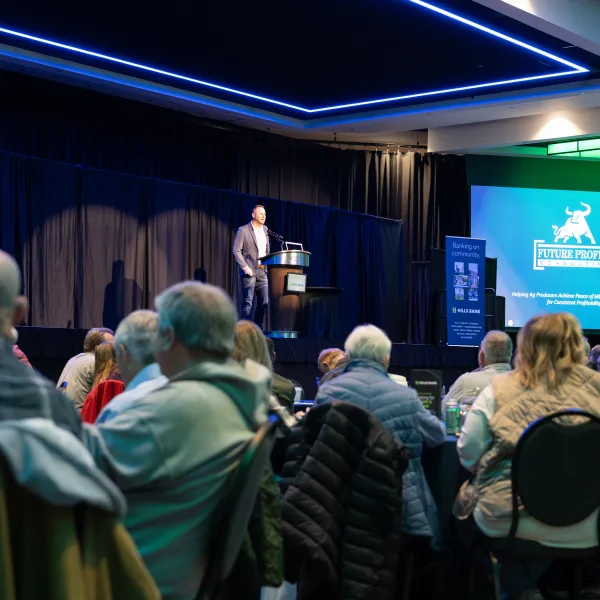
At this year’s Ag Outlook, Adam Hocker of Future Profits Consulting delivered a clear message to producers facing volatile markets: consistent profitability in agriculture does not happen by accident—it must be built intentionally.
Speaking to a room of farmers navigating tight margins, shifting weather patterns, and global uncertainty, Hocker focused his presentation on risk management and the need for a structured approach to managing profitability. He emphasized that while farmers often excel at production, many operations lack a repeatable system for making marketing and financial decisions.
“Most people farm because they want control—control of their land, their time, and their future,” Hocker said. “But when it comes to managing profitability, many operations are operating completely out of control.”
Volatility Is Not the Enemy
Hocker outlined a wide range of external pressures facing today’s farm businesses, including weather variability, disease pressure, geopolitical conflict, trade policy, biofuel regulations, and the rapid spread of market information through technology. While none of these factors are new, he argued that the speed and intensity with which they affect markets has increased.
“These pressures aren’t going away,” Hocker said. “The only thing we can control is how we respond to them.”
According to Hocker, volatility itself is not the problem. In fact, he said volatility can create opportunity—if producers are prepared to act with confidence rather than emotion.
Internal Gaps Create the Biggest Risk
Much of Hocker’s presentation focused on what he called “internal gaps” within farm operations. Chief among them: not knowing the true cost of production.
“If you don’t know your cost, you don’t know what a good price is,” he said. “And if you don’t know what a good price is, every decision becomes a guess.”
He noted that many producers prioritize day-to-day operations over financial analysis, often because they enjoy the work of farming more than managing spreadsheets or reconciling accounts. As a result, marketing decisions are frequently driven by gut instinct, opinions, or headlines rather than clear profit targets.
“The commodity market doesn’t care what your cost is,” Hocker said. “Profitability is not automatic, and it’s not guaranteed.”
The Cost of Waiting
Hocker challenged what he described as the most common marketing strategy in agriculture: waiting for higher prices.
Whether costs are high, moderate, low, or unknown, he said most producers default to waiting—hoping for a rally, reacting to USDA reports, or following opinions that confirm their expectations.
“The market doesn’t reward patience,” Hocker said. “It rewards preparation.”
Using real-world examples, he demonstrated how thin margins can quickly turn profitable scenarios into losses with relatively small price movements. In one illustration, a 30-cent drop in corn prices was enough to erase an already narrow margin, highlighting the risk of inaction when profitability is not protected.
A System, Not a Prediction
Rather than trying to predict market highs or lows, Hocker advocated for what he called an “Agricultural Profitability System”—a structured process designed to manage margin instead of chasing price.
The system begins with realistic production forecasts based on historical yields, followed by a clear understanding of costs. From there, producers can evaluate margin opportunities, adjust assumptions as conditions change, and execute marketing strategies aligned with their risk tolerance and financial needs.
“We’re not trying to guess where the market is going,” Hocker said. “We’re organizing information so we can make decisions that are right for your business.”
He compared the approach to crop production itself, noting that farmers already rely on repeatable processes in the field. Profitability, he argued, should be treated the same way.
Reducing Emotion, Increasing Discipline
Throughout the presentation, Hocker returned to the role of emotion in farm decision-making. He described how greed, hope, and fear often drive marketing choices—particularly during seasonal price movements—and warned against relying on opinions without accountability.
“When structure is missing, emotion takes over,” he said.
By focusing on margin and return rather than price alone, Hocker said producers can begin to think more like investors in their own businesses. This shift, he added, not only improves decision-making but also strengthens credibility with lenders.
“Clear margin information builds confidence—with yourself and with your lender,” Hocker said. “Structure becomes a competitive advantage.”
Building for the Next Generation
Hocker closed his presentation by framing profitability as a generational responsibility. Farming, he said, is not just about surviving difficult years but about creating stability for those who may one day take over the operation.
“A legacy is more than survival,” he said. “It’s building something that can withstand pressure and still move forward intentionally.”
As volatility continues to increase across global agricultural markets, Hocker urged producers to move away from hope-based decision-making and toward disciplined systems that support long-term sustainability.
“The future of agriculture won’t be built on luck,” he said. “It will belong to the most disciplined.”