Why Roth Conversions Deserve a Second Look
If you have a significant balance in a 401(k) or IRA, a Roth IRA conversion could help you keep more of what you’ve earned – thanks to recent tax law changes that have quietly shifted the math in favor of retirees.
We'll explain that math in a moment, but first: what is a Roth conversion?
What is a Roth IRA Conversion?
A Roth IRA conversion is the process of moving money from a traditional individual retirement account, like a 401(k) or traditional IRA, into a Roth IRA. You’ll pay income tax on the converted amount in the year of the conversion, but subsequent withdrawals become tax-free.
The Impact of the “One Big Beautiful Bill Act”
When this bill was signed, many breathed a sigh of relief: tax brackets won’t increase in 2026 as originally planned. But there’s a lesser-known detail that could be even more important for retirement planning: the width of the tax brackets also stayed the same.
This matters because you now have more room to convert pre-tax retirement funds to Roth accounts at lower tax rates. Under the old law, many brackets would have narrowed, limiting how much you could convert before spilling into a higher tax rate. Now, with the current structure locked in, strategic Roth conversions are more attractive than ever.
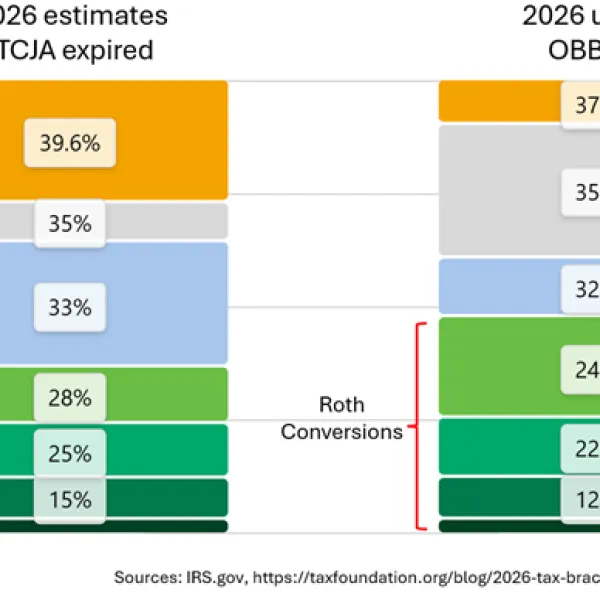
How the Brackets Would Have Changed (Married Filing Jointly)
- The first and second brackets would have seen minimal changes.
- The third bracket would have increased from 22% to 25%.
- The fourth bracket – currently 24% – would have been the tipping point.
Under the extended tax cuts, you can have taxable income of over $400,000 as a married couple and still stay in the 24% bracket. If the cuts had expired, that same income would have pushed you into the 28% or even 33% bracket, significantly increasing your tax bill.
What This Means for You
The extension of the tax cuts means that retirees now have a wider window to make larger, more strategic Roth conversions without jumping into higher tax brackets. This can lead to:
- Lower lifetime taxes
- More tax-efficient retirement income
- Greater flexibility in future financial planning
Ultimately, retirement planning isn’t just about numbers – it’s about making sure you can enjoy the life you’ve built here in our community. Whether your dream is more time with family, supporting grandkids through college, or keeping the family business strong, smart tax planning can help make you make it a reality.
Ultimately, the decision requires careful consideration of your personal financial situation, income, and long-term outlook. I highly recommended consulting a qualified financial advisor and tax professional (CPA) to model the impact and determine the best strategy for your specific circumstances.
Take the Next Step
Tax laws change – but your goals haven’t. We’ll help you make the most of today’s opportunities so you can focus on what matters most.
Our team lives and works right here in Eastern Iowa, and we understand the unique needs of families in our community. Reach out to a local Hills Bank advisor for a free consultation – we’ll help you evaluate your Roth conversion options and create a plan that gives you confidence for the future.
Investment products are not insured by the FDIC, are not deposits, and may lose value